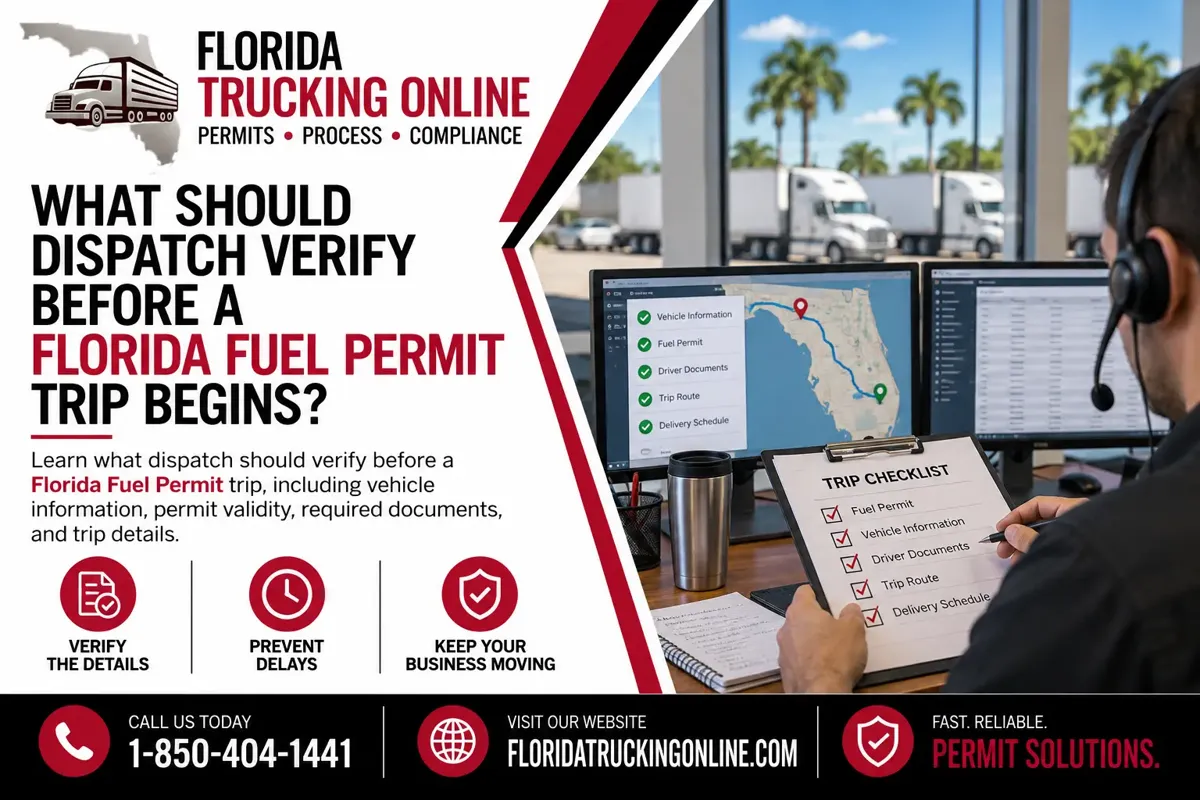
What Should Dispatch Verify Before A Florida Fuel Permit Trip Begins?
Table Of Contents
-
Introduction
-
Confirm The Correct Fuel Authorization
-
Verify The Vehicle Information
-
Check The Permit Validity Period
-
Make Sure The Driver Has The Documents
-
Review The Planned Trip
-
Separate Fuel And Registration Requirements
-
Common Mistakes To Avoid
-
Why Many Trucking Companies Choose Our Service
-
FAQ
Introduction
Before an out-of-state truck enters Florida, dispatch should confirm that the vehicle has the correct fuel-tax credentials for the planned operation. A Florida Fuel Permit is a temporary authorization used by qualifying carriers that do not operate under the applicable IFTA credentials.
Obtaining the permit is only one part of preparation. Dispatch should verify the document, vehicle information, validity period, driver paperwork, and planned route before departure.
A pre-trip review can help prevent missing, incorrect, or expired documentation.
Confirm The Correct Fuel Authorization
The first step is determining whether the truck needs a Florida Fuel Permit or already has the appropriate IFTA credentials.
Florida requires vehicles subject to its fuel-tax rules to have either an IFTA license and decal or a temporary fuel-use permit before operating on Florida highways. A temporary fuel-use permit is intended for carriers that need temporary fuel-tax authorization rather than operating under an IFTA license.
Dispatch should therefore confirm the carrier's fuel-tax status before ordering a permit.
For multi-state operations, do not assume one credential satisfies every requirement. Fuel-tax authorization and registration are separate issues.
Verify The Vehicle Information
Once dispatch confirms that a temporary fuel permit is appropriate, the next step is checking the vehicle information.
Compare the permit with the truck that will actually enter Florida. Review the identifying information shown on the document and confirm that it matches the assigned vehicle.
This check becomes particularly important when dispatch changes equipment shortly before departure. A replacement tractor or another vehicle should not simply be treated as covered because the original truck had a valid permit.
If the truck changes after the permit is issued, dispatch should review the situation before the replacement vehicle enters Florida.
Check The Permit Validity Period
Florida Temporary Fuel Use Permits are valid for 10 days. Dispatch should check the effective date and expiration date before the trip begins and make sure the planned operation fits within that period.
A permit's validity should not be confused with the driver's schedule. A delayed pickup, customer appointment, mechanical problem, or other interruption can consume part of the available period.
For that reason, dispatch should review the permit again when a trip is delayed. Do not assume that a document remains valid simply because it was valid when it was originally purchased.
The driver should also know the expiration date so a delay can be reported promptly.
Make Sure The Driver Has The Documents
A permit is only useful if the driver has access to it while operating the vehicle.
Before departure, dispatch should provide the driver with the required permit documentation and confirm that it is readable and available in the truck. Florida requires the temporary fuel-use permit to be carried as required for the vehicle's operation.
The fuel permit does not replace driver qualifications, vehicle registration, insurance, or other required paperwork. Keeping the documents together can make inspections easier.
Review The Planned Trip
Dispatch should review the planned Florida operation before the truck enters the state.
Confirm the expected entry date, the areas where the truck will operate, and the expected exit from Florida. If delivery schedules have changed, make sure the new plan still fits within the permit's validity period.
The return trip should also be considered. A truck may remain in Florida after delivery, so dispatch should account for the full period of operation.
If the customer adds a stop, changes the delivery schedule, or creates another delay, dispatch should reassess the timing before the truck continues operating under the temporary permit.
Separate Fuel And Registration Requirements
One of the most important dispatch checks is understanding that a Florida Fuel Permit and a Florida IRP Trip Permit address different requirements.
The fuel-use permit concerns fuel-tax authorization. The IRP Trip Permit concerns temporary registration for qualifying out-of-state vehicles.
A carrier may need one, the other, or both depending on the vehicle and its registration and fuel-tax status.
Dispatch should therefore verify each requirement independently. Having a fuel permit does not automatically mean the truck has all the registration credentials it needs, and having an IRP credential does not automatically eliminate fuel-tax requirements.
Separating these checks before departure can prevent a driver from discovering a missing credential after entering Florida.
Common Mistakes To Avoid
One common mistake is purchasing a fuel permit without confirming whether the truck already operates under IFTA credentials or another applicable arrangement.
Another mistake is checking the permit number but not comparing the document with the actual vehicle. Equipment substitutions can create problems when the original permit information no longer matches the truck.
Carriers should also avoid overlooking the permit's expiration date. A schedule change can leave less time than expected for the Florida portion of the trip.
A further mistake is giving the permit to the driver without confirming the validity period and required paperwork.
Finally, dispatch should not treat the fuel permit as the only credential needed for Florida operations. Registration and fuel-tax requirements should be reviewed separately.
Why Many Trucking Companies Choose Our Service
Preparing a Florida Fuel Permit before a trip requires careful attention to vehicle information, permit dates, documents, and trip planning. Florida Trucking Online helps trucking companies with fast processing, experienced permit specialists, secure online applications, 24/7 customer support, weekend and holiday availability, and competitive pricing.
Our service helps trucking companies organize temporary fuel permit requirements before the truck begins its Florida trip.
FAQ
What should dispatch verify before a Florida Fuel Permit trip?
Dispatch should confirm the correct fuel authorization, vehicle information, permit validity period, driver documents, and planned trip details.
How long is a Florida Temporary Fuel Use Permit valid?
A Florida Temporary Fuel Use Permit is valid for 10 days.
Should the permit be checked if the truck is replaced?
Yes. If the vehicle changes, dispatch should review the permit because the document may identify specific vehicle information.
Does a fuel permit replace an IRP Trip Permit?
No. Fuel-tax authorization and temporary registration are separate requirements.
Should the driver carry the Florida Fuel Permit?
Yes. The required permit documentation should remain available in the vehicle while operating in Florida.
What if a delivery is delayed after the permit is issued?
Dispatch should review the permit's remaining validity period and make sure the truck can continue operating in Florida under the applicable authorization.
For more information, visit the Florida Highway Safety and Motor Vehicles.