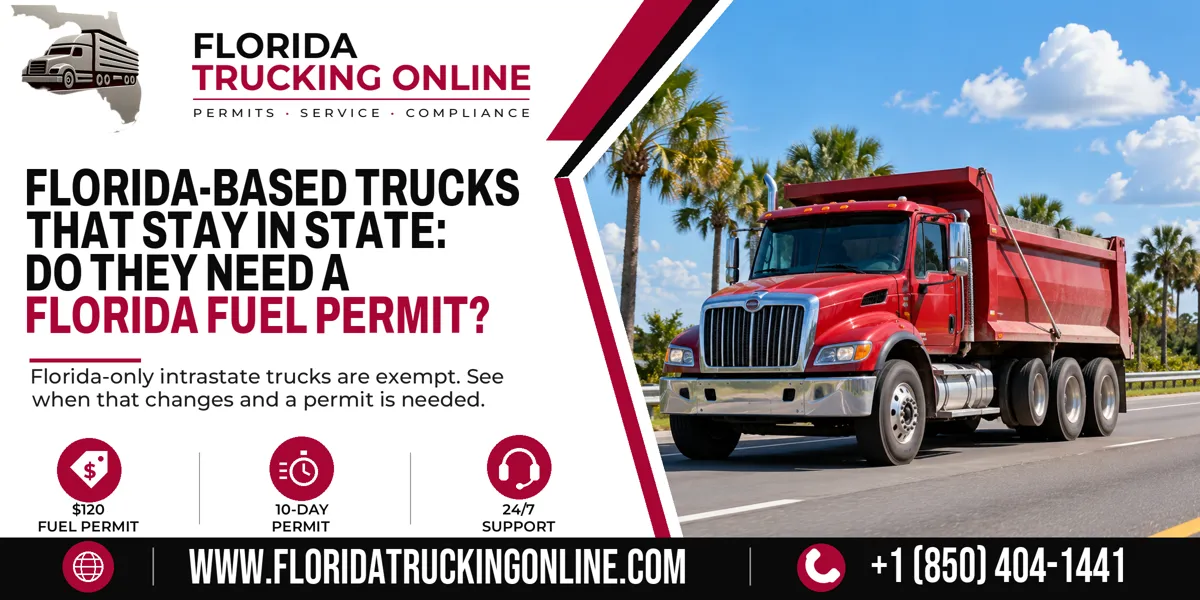
Florida-Based Trucks That Only Run Inside Florida: Do They Need a Fuel Permit?
Table Of Contents
-
Introduction
-
The Short Answer
-
What Florida Law Requires
-
Is Your Truck a Qualified Motor Vehicle?
-
The Intrastate-Only Exemption
-
When a Florida Truck Loses the Exemption
-
What a Florida Fuel Permit Covers
-
Penalties for Running Without Credentials
-
Why Many Trucking Companies Choose Our Service
-
FAQ
Introduction
Plenty of Florida trucks never cross a state line. Dump trucks on local construction jobs, produce haulers running from the fields to Florida packing houses, and fleets serving ports and warehouses inside the state can spend their whole working lives in Florida.
If that describes your operation, you may be wondering whether you need IFTA credentials or a Florida Fuel Permit at all. Florida law answers that question directly, and the answer depends on one thing: whether your truck really stays inside Florida.
The Short Answer
Under Florida law, Florida-based vehicles that travel only Florida intrastate mileage are exempt from the requirement to hold IFTA credentials or a temporary fuel-use permit. A truck that is based in Florida and never leaves the state does not need a Florida Fuel Permit.
The exemption ends the moment the truck's operation is no longer intrastate-only. That is where many carriers get caught.
What Florida Law Requires
Florida's fuel use tax rules are in Chapter 207 of the Florida Statutes, now titled "Motor Fuel Use Tax." Section 207.004 says a motor carrier may not operate a qualified motor vehicle in Florida until the carrier is either:
-
Licensed under the International Fuel Tax Agreement (IFTA) and issued fuel tax decals, or
-
Issued a temporary fuel-use permit.
The same section carves out the exemption for Florida-based vehicles that travel only Florida intrastate mileage.
Is Your Truck a Qualified Motor Vehicle?
The rules only apply to qualified motor vehicles. Under section 207.002, a qualified motor vehicle is one that is not owned or operated by a government and:
-
Has two axles and a gross vehicle weight of more than 26,000 pounds, or
-
Has three or more axles, regardless of weight, or
-
Is used in a combination weighing more than 26,000 pounds.
The definition excludes recreational vehicles and certain community transportation and contracted transit vehicles. A two-axle truck at 26,000 pounds or less is not a qualified motor vehicle.
The Intrastate-Only Exemption
For the exemption to apply, two things must both be true:
-
The vehicle is Florida-based. Chapter 207 does not define "Florida-based" in detail, so carriers with trucks registered or garaged in another state should confirm their status with the Florida Department of Highway Safety and Motor Vehicles (FLHSMV).
-
The vehicle travels only Florida intrastate mileage. Every mile, on every trip, stays in Florida.
A Florida-based dump truck that runs from a Polk County mine to job sites around Tampa fits the exemption. So does a Miami-area tractor that only moves containers between the port and local warehouses.
When a Florida Truck Loses the Exemption
The exemption is about where the truck actually goes, not where the company usually works. Common situations that take a Florida truck outside it:
-
A one-time load to Georgia or Alabama. Even a short run across the state line means the truck is no longer traveling only Florida intrastate mileage.
-
A backhaul offer from out of state. A broker load that picks up in Valdosta or Dothan turns an intrastate truck into an interstate one.
-
Moving equipment for a customer in another state. Equipment haulers often get these requests with little notice.
-
Adding a truck from an interstate fleet. A unit that also runs other states does not share the intrastate exemption.
At that point, the carrier needs IFTA credentials or a temporary fuel-use permit to operate the qualified motor vehicle in Florida. The other state on the trip may also have its own fuel permit rules, so check those before the truck leaves.
What a Florida Fuel Permit Covers
For carriers who only leave Florida now and then, a temporary permit is often simpler than setting up a full IFTA account. Under section 207.004:
-
The state fee for a temporary fuel-use permit is $45.
-
The permit expires 10 days after the date of issuance.
-
The permit must identify the carrier, the vehicle, and the dates it covers, and the holder may not let anyone else use it.
-
The permit does not exempt you from fuel tax paid at the pump under Chapter 206.
If out-of-state trips become regular, IFTA licensing is usually the better long-term choice.
Penalties for Running Without Credentials
Florida takes fuel use tax compliance seriously. Under Chapter 207:
-
A willful violation can be charged as a third-degree felony.
-
Each day a vehicle operates without decals or a valid permit is a separate offense.
-
The state may seize vehicles of a carrier that refuses to comply.
A truck that loses the intrastate exemption on a single trip should not run that trip without the right credentials.
Why Many Trucking Companies Choose Our Service
Florida Trucking Online helps Florida carriers know when the intrastate exemption applies and when a truck needs a Florida Fuel Permit. When a Florida truck takes an out-of-state load, we can get the permit ready before it rolls.
- Fuel permit: $120
We provide support 24/7 and also work weekends and holidays.
or
FAQ
-
Does a Florida truck that never leaves Florida need a fuel permit?
No. Florida law exempts Florida-based vehicles that travel only Florida intrastate mileage from IFTA and temporary fuel-use permit requirements.
-
What if my Florida truck makes one trip to Georgia?
The truck is no longer intrastate-only, so it needs IFTA credentials or a temporary fuel-use permit for Florida, and you should check Georgia's rules too.
-
How long is a Florida Fuel Permit valid?
It expires 10 days after the date of issuance.
-
Does a fuel permit replace paying fuel tax at the pump?
No. The permit does not exempt the carrier from fuel tax under Chapter 206.
-
Do pickups and small box trucks need a permit?
A two-axle truck at 26,000 pounds or less is not a qualified motor vehicle, so the requirement does not apply.
For more information, visit the Florida Department of Highway Safety and Motor Vehicles.