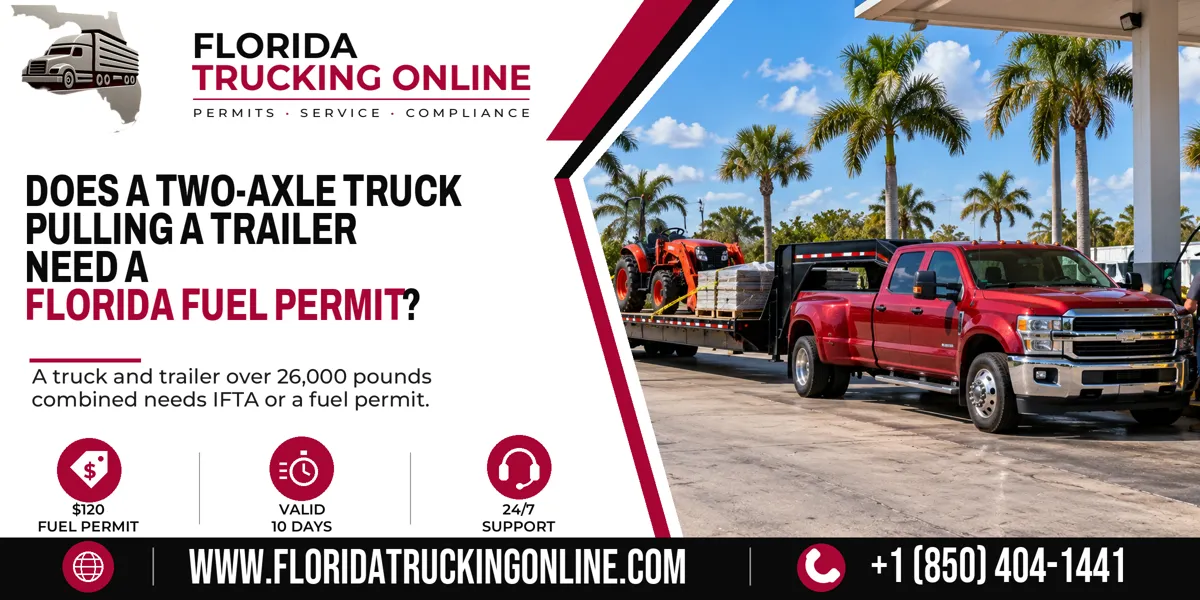
Does a Two-Axle Truck Pulling a Trailer Need a Florida Fuel Permit?
Table Of Contents
-
Introduction
-
The Short Answer
-
What Florida Law Says
-
Why the Trailer Changes Everything
-
How to Figure Out Your Combination Weight
-
Examples
-
Who Does Not Need the Permit
-
What Happens If You Run Without One
-
Common Mistakes to Avoid
-
Why Many Trucking Companies Choose Our Service
-
FAQ
Introduction
Plenty of small carriers run two-axle trucks: hotshot pickups, box trucks, and medium-duty tractors. On their own, many of these trucks weigh well under 26,000 pounds, so owners assume Florida's fuel tax rules don't apply.
That changes the moment a trailer is hooked up. Under Florida law, a two-axle truck pulling a trailer can become a qualified motor vehicle and need IFTA credentials or a Florida Fuel Permit before it enters the state. This guide explains when.
The Short Answer
Yes, if the combined weight of the truck and trailer exceeds 26,000 pounds. Florida treats a vehicle "used in combination" over 26,000 pounds as a qualified motor vehicle, even if the truck has only two axles.
An out-of-state carrier without IFTA decals needs a Florida Fuel Permit for that combination before operating in Florida.
What Florida Law Says
Florida's motor fuel use tax rules are in Chapter 207 of the Florida Statutes. Under section 207.002(11), a qualified motor vehicle is any vehicle not owned or operated by a government entity that uses motor fuel on public highways and:
-
Has two axles and a gross vehicle weight or registered gross vehicle weight over 26,000 pounds, or
-
Has three or more axles, regardless of weight, or
-
Is used in combination when the weight of the combination exceeds 26,000 pounds.
Under section 207.004(1)(a), a motor carrier may not operate a qualified motor vehicle in Florida until it is licensed under IFTA and has fuel tax decals, or has a temporary fuel-use permit for each vehicle. The only exception is a Florida-based vehicle that runs Florida intrastate miles only.
Why the Trailer Changes Everything
The two-axle test looks at the truck's own weight. The combination test looks at the truck and trailer together. A truck can pass the first test and still fail the second.
For example, a two-axle pickup rated at 14,000 pounds is not a qualified motor vehicle by itself. Hook up a gooseneck trailer carrying a load, and the combination can easily reach 30,000 pounds or more. At that point it meets the combination rule, and the fuel credential requirement applies.
How to Figure Out Your Combination Weight
-
Check the Truck. Find the gross vehicle weight rating or the registered weight.
-
Check the Trailer. Find the trailer's gross weight rating or loaded weight.
-
Add Them Together. The total is your combination weight.
-
Compare to 26,000 Pounds. If the total is over 26,000 pounds, the combination is a qualified motor vehicle.
-
Plan for Your Heaviest Trip. Use the heaviest load the combination will carry in Florida.
When in doubt, a certified scale ticket gives you a clear answer.
Examples
| Setup | Combination Weight | Florida Fuel Permit or IFTA Needed? |
|---|---|---|
| Two-axle pickup, no trailer | 12,000 lbs | No |
| Two-axle pickup with loaded gooseneck | 33,000 lbs | Yes |
| Two-axle box truck, no trailer | 25,500 lbs | No |
| Two-axle box truck pulling a small trailer | 29,000 lbs | Yes |
| Two-axle truck with empty trailer | 21,000 lbs | No |
If you sometimes run loaded and sometimes empty, plan for the trips that go over 26,000 pounds.
Who Does Not Need the Permit
Section 207.002(11) excludes some vehicles from the definition entirely:
-
Recreational vehicles,
-
Vehicles owned or operated by a government entity,
-
Vehicles owned or operated by a community transportation coordinator or a private operator under contract to provide public transit.
And under section 207.004(1)(a), a Florida-based qualified motor vehicle that travels Florida intrastate miles only does not need IFTA decals or a temporary permit.
What Happens If You Run Without One
Florida takes this seriously. Under section 207.007(3), violating the chapter is a third-degree felony when no other penalty applies, and each day a qualified motor vehicle runs without decals or a valid temporary fuel-use permit is a separate offense.
Under section 207.023(3), qualified motor vehicles of a carrier that refuses to comply may be seized.
Remember that a Florida Fuel Permit lasts 10 days from the date of issuance. It must identify the carrier, the vehicle, and the effective and expiration dates, and it must be carried in that vehicle.
Common Mistakes to Avoid
-
Looking only at the truck's weight. The trailer counts once they're hooked together.
-
Assuming two axles means no permit. The combination rule applies to any axle count.
-
Planning for the empty trip. Use the heaviest loaded weight in Florida.
-
Buying the permit too early. The 10 days start on the date of issuance.
-
Forgetting the copy. The permit must be carried in the vehicle it names.
Why Many Trucking Companies Choose Our Service
Florida Trucking Online helps hotshot drivers and small fleets figure out when a truck and trailer need a Florida Fuel Permit, then issues it fast so you can roll.
-
Fuel permit: $120
-
Trip permit: $105
-
Oversize permit: $97
We provide support 24/7 and also work weekends and holidays.
or
FAQ
-
Does a two-axle truck need a Florida Fuel Permit?
Only if its weight is over 26,000 pounds or if it pulls a trailer and the combination is over 26,000 pounds.
-
Does a hotshot pickup with a gooseneck need one?
Yes, if the loaded combination is over 26,000 pounds and the carrier has no IFTA decals.
-
How long is a Florida Fuel Permit valid?
It expires 10 days after the date of issuance.
-
Do I need a permit if I only drive inside Florida?
Not if the vehicle is Florida-based and travels Florida intrastate miles only.
-
Can I get in trouble for running without one?
Yes. It can be a third-degree felony, and each day is a separate offense.
For more information, visit the Florida Department of Highway Safety and Motor Vehicles.