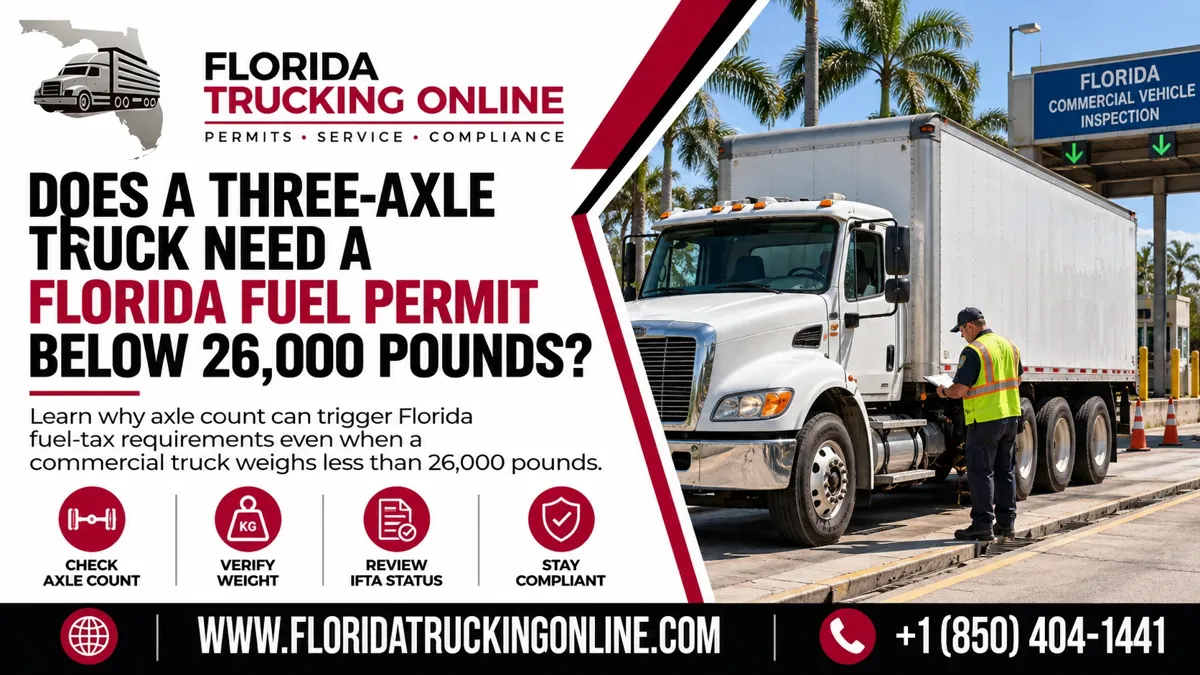
Does a Three-Axle Commercial Truck Need a Florida Fuel Permit Even if It Weighs Less Than 26,000 Pounds?
Table Of Contents
-
Introduction
-
Why Axle Count Matters in Florida
-
Which Vehicles Qualify Under the Rule?
-
Do You Need a Florida Fuel Permit or IFTA Credentials?
-
What Carriers Should Check Before Entering Florida
-
Common Mistakes to Avoid
-
Why Many Trucking Companies Choose Our Service
-
FAQ
Introduction
A commercial truck does not have to weigh more than 26,000 pounds to fall under Florida's fuel-use tax rules. A vehicle with three or more axles may qualify regardless of weight, subject to statutory exclusions.
A lighter three-axle truck may therefore need the appropriate fuel-tax credentials before operating on Florida's public highways. Understanding this rule helps carriers avoid assuming that a vehicle is exempt simply because its weight falls below the commonly referenced threshold.
Why Axle Count Matters in Florida
Florida law uses three separate tests to define a qualified motor vehicle: a two-axle vehicle exceeding 26,000 pounds gross or registered gross vehicle weight; a vehicle with three or more axles regardless of weight; or a vehicle combination exceeding 26,000 pounds gross or registered gross vehicle weight.
The three-axle test is separate from the weight threshold. For example, a commercial truck with three axles and a registered weight of 24,000 pounds may still qualify based on axle count alone.
The vehicle must also use motor fuel on public highways, and statutory exclusions may apply. Check axle count, fuel type, vehicle use, registration details, and any claimed exception before deciding whether the vehicle is covered.
Which Vehicles Qualify Under the Rule?
The rule can affect different commercial vehicles, including certain straight trucks, service trucks, and power units. The actual configuration and use matter.
A three-axle vehicle does not automatically need every possible trucking credential. Fuel-tax requirements are separate from vehicle registration, operating authority, oversize permits, and other authorizations.
Florida law excludes certain vehicles, including qualifying government vehicles, recreational vehicles, and specified public-transit-related vehicles. Do not assume an exclusion applies because a truck has a special purpose; verify that the vehicle and its operation meet the precise criteria.
If the truck pulls a trailer, review the power unit and combination details carefully. The combination-weight test is a separate basis for qualification, while a three-axle power unit may qualify even when the combination remains below 26,000 pounds.
Do You Need a Florida Fuel Permit or IFTA Credentials?
Once a vehicle qualifies, the carrier must confirm which fuel-tax authorization applies before it operates in Florida. For covered interstate operations, carriers generally use an active International Fuel Tax Agreement (IFTA) license and the required fuel-tax decals, or a valid temporary fuel-use permit when appropriate. Florida-based qualified vehicles that travel only intrastate mileage are treated differently under the statute.
An IFTA license supports ongoing interstate fleet operations and fuel-tax reporting across participating jurisdictions. A temporary fuel-use permit is vehicle-specific and valid for a limited period. Florida law states that a temporary fuel-use permit expires 10 days after issuance and must identify the carrier, vehicle, and effective and expiration dates.
A temporary permit does not replace vehicle registration or an oversize permit, and it does not remove ordinary fuel tax paid at the pump. Confirm the credential required for your carrier and trip before dispatch.
What Carriers Should Check Before Entering Florida
Before dispatching a three-axle truck, verify the following:
-
Count the axles. Confirm the actual configuration of the power unit; do not rely only on its weight rating.
-
Check weight records. Review gross and registered gross vehicle weight, especially if the truck operates with a trailer.
-
Confirm fuel-tax status. Check whether the carrier's IFTA license and decals are current or whether temporary authorization is needed.
-
Verify the vehicle listed. Fuel-tax decals and temporary permits are vehicle-specific and should not be transferred between trucks.
-
Review exceptions carefully. If you believe the vehicle is exempt, confirm that the applicable statutory exclusion covers the vehicle and operation.
-
Keep documents accessible. Ensure the driver has the required license copy or electronic access and any applicable permit or decal.
If the truck's axle configuration or ownership changes, review the credentials again before its next Florida trip. When the requirements are unclear, contact the Florida licensing authority or a permit provider rather than guessing.
Common Mistakes to Avoid
Do not assume that a truck below 26,000 pounds is automatically exempt. The three-or-more-axle rule can apply regardless of weight. Do not confuse fuel-tax requirements with IRP registration, a trip permit, or an oversize permit.
Avoid using another truck's decal or permit, and do not rely on an application receipt as proof that the required authorization has been issued. If your vehicle meets the definition of a qualified motor vehicle, confirm the appropriate fuel-tax credentials before it enters Florida's public highways.
Why Many Trucking Companies Choose Our Service
Florida Trucking Online helps carriers navigate permit applications and organize the vehicle information needed for Florida operations. Clear, accurate details can save time, simplify paperwork, and help prevent avoidable delays caused by incomplete applications.
Our service provides practical permit assistance and customer support to help trucking companies prepare the required information and understand which steps to verify before a trip. Carriers remain responsible for meeting the requirements that apply to their vehicles and operations.
FAQ
-
Does a three-axle truck need a Florida Fuel Permit if it weighs less than 26,000 pounds?
It may. Florida's qualified-motor-vehicle definition includes vehicles with three or more axles regardless of weight, unless an applicable exclusion applies. -
Does every three-axle vehicle automatically need a temporary fuel-use permit?
Not necessarily. The carrier must determine whether it is covered by applicable IFTA credentials, needs temporary authorization, or qualifies for an exception under Florida law. -
Does a Florida Fuel Permit replace IFTA credentials?
A temporary fuel-use permit is a separate, time-limited authorization for a qualifying vehicle. Confirm the appropriate option for your carrier and trip. -
How long is a Florida temporary fuel-use permit valid?
Florida law states that it expires 10 days after issuance. Verify the effective and expiration dates on the permit. -
What should I check before sending a three-axle truck into Florida?
Check axle count, registration and weight records, IFTA status, vehicle-specific decals or permits, and any claimed statutory exemption.
For more information, review the Florida Statutes, Chapter 207.