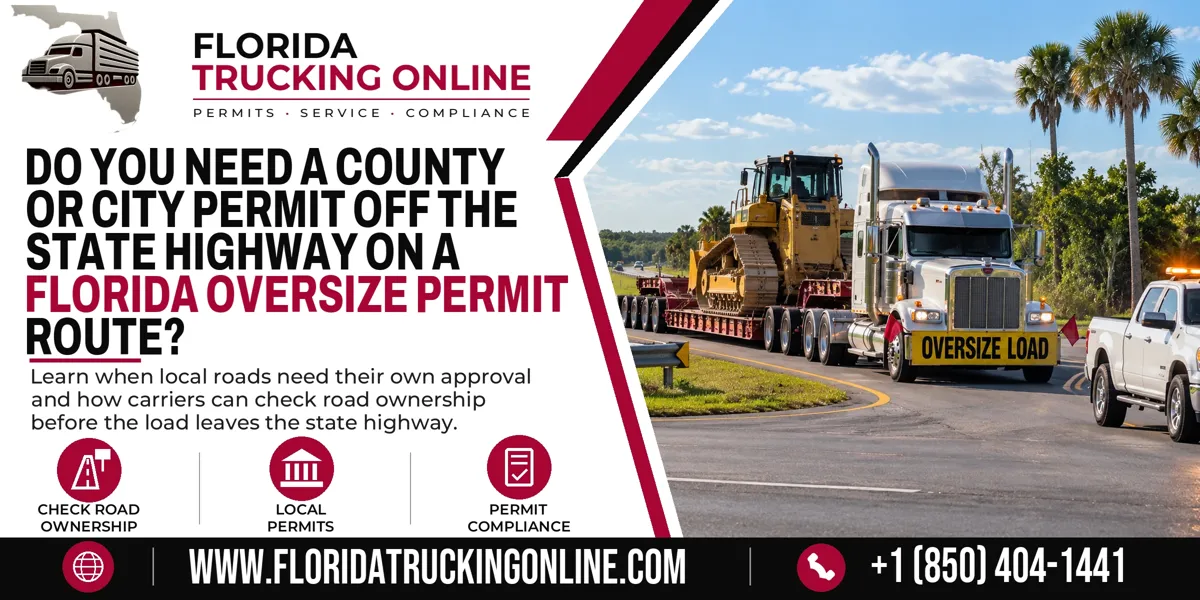
Do You Need a Separate County or City Permit After Leaving the State Highway in Florida?
Table Of Contents
-
Introduction
-
What a Florida Oversize Permit From FDOT Covers
-
Where State Jurisdiction Ends
-
When a County or City Permit May Be Needed
-
How to Plan the Last Miles of Your Route
-
Common Mistakes to Avoid
-
Why Many Trucking Companies Choose Our Service
-
FAQ
Introduction
Most oversize and overweight loads in Florida spend the bulk of their trip on interstates, U.S. routes, and state roads. But the job site, port terminal, or yard at the end of the run is often on a county road or city street. That raises a common question for carriers: does your Florida Oversize Permit still cover you once you turn off the state highway?
The short answer is often no. A permit from the Florida Department of Transportation (FDOT) is generally tied to the State Highway System, while local roads are controlled by the county or municipality that maintains them. This guide explains how that split works and how to plan for it so your load stays legal from origin to final delivery.
What a Florida Oversize Permit From FDOT Covers
FDOT's Permits Office issues oversize and overweight (OS/OW) permits for vehicles and loads that exceed Florida's legal size or weight limits. These permits authorize travel on the State Highway System, which includes the roads FDOT is responsible for, such as interstates and numbered state routes.
A Florida Oversize Permit from FDOT typically lists the approved route, dimensions, weight, and any travel conditions. It is not a blanket authorization for every road in Florida. Roads owned and maintained by counties and cities generally fall under local authority, and local governments may issue permits for their own roads.
Rules, fees, and procedures can change, so always confirm current requirements directly with FDOT and with the local agency involved.
Where State Jurisdiction Ends
The tricky part is that drivers rarely see a clear sign saying "state highway ends here." A road can carry a familiar name while switching from state to county maintenance, and many city streets connect directly to state routes.
Here are some general points to keep in mind:
-
A state road number usually signals FDOT jurisdiction. Roads marked as SR or interstate routes are typically part of the State Highway System.
-
County roads (CR) are generally county-maintained. These are usually controlled by the county's public works or engineering department.
-
City streets belong to the municipality. Downtown streets, industrial park roads, and local connectors are often city-owned.
-
Some roads are privately owned or controlled by other authorities. Ports, airports, and toll agencies may have their own rules.
If you are unsure who owns a road, check with FDOT or the local public works department before the move.
When a County or City Permit May Be Needed
If any part of your route uses a county road or city street, and your load exceeds legal limits, you may need a separate local permit. Requirements vary widely across Florida's counties and municipalities. Some issue formal OS/OW permits, some require a right-of-way or moving permit, and some may require a police escort or restricted travel times in busy areas.
Situations where a local permit is commonly required include:
-
Final-mile delivery to a job site located on a county road or city street.
-
Pickup from a yard or plant that sits off the state system.
-
Routes through downtown areas where cities control traffic signals, turns, and travel hours.
-
Superloads or very wide loads that may need utility, signal, or law enforcement coordination.
There is no single rule that applies to every local jurisdiction, so treat each county and city as its own authority and verify before you move.
How to Plan the Last Miles of Your Route
-
Map the Full Route, Door to Door. Include every road from origin to destination, not just the state highway portion.
-
Identify Who Owns Each Road. Mark which segments are state, county, city, or private.
-
Secure Your FDOT Permit First. Get your Florida Oversize Permit for the state system and note the exact exit point.
-
Contact Each Local Agency Early. Ask the county or city about permit forms, fees, processing times, escort needs, and travel restrictions.
-
Carry All Permits in the Cab. Keep the FDOT permit and every local permit available for inspection.
-
Check for Restrictions and Changes. Watch for construction, low clearances, weight-posted bridges, and local curfews.
Common Mistakes to Avoid
-
Assuming the FDOT permit covers the whole trip. It is generally limited to the State Highway System.
-
Ignoring short local segments. Even a few blocks on a city street can require local approval.
-
Waiting until the last minute. Some local agencies may need several days to review a request.
-
Skipping escort or police requirements. Local rules may differ from state rules.
-
Relying on the road name alone. Ownership can change along the same road, so verify jurisdiction.
Why Many Trucking Companies Choose Our Service
Florida Trucking Online helps carriers get the right Florida Oversize Permit for their route and understand where state coverage ends. We help you spot the local segments that may need extra approval, so you can plan the full move with fewer surprises.
Our team offers fast, practical support for owner-operators and fleets of every size. Carriers remain responsible for following current FDOT and local rules and for keeping their permits and records accurate.
FAQ
-
Does a Florida Oversize Permit from FDOT cover county roads?
Generally no. FDOT permits typically cover the State Highway System. County roads are usually controlled by the county, which may require its own permit.
-
Do cities in Florida issue their own oversize permits?
Many municipalities control their own streets and may require a permit for oversize or overweight loads. Check with the city's public works or transportation department.
-
How do I know if a road is state-maintained?
State roads are often marked with SR or interstate numbers, but ownership can change along a route. Confirm with FDOT or the local agency.
-
Can I get local permits at the same time as my FDOT permit?
Local permits are usually handled separately by each county or city. Apply early, since processing times vary.
-
What happens if I travel on a local road without a required permit?
You may face fines, delays, or being stopped until proper authorization is obtained. Penalties vary by jurisdiction.
For more information, visit the Florida Department of Transportation.