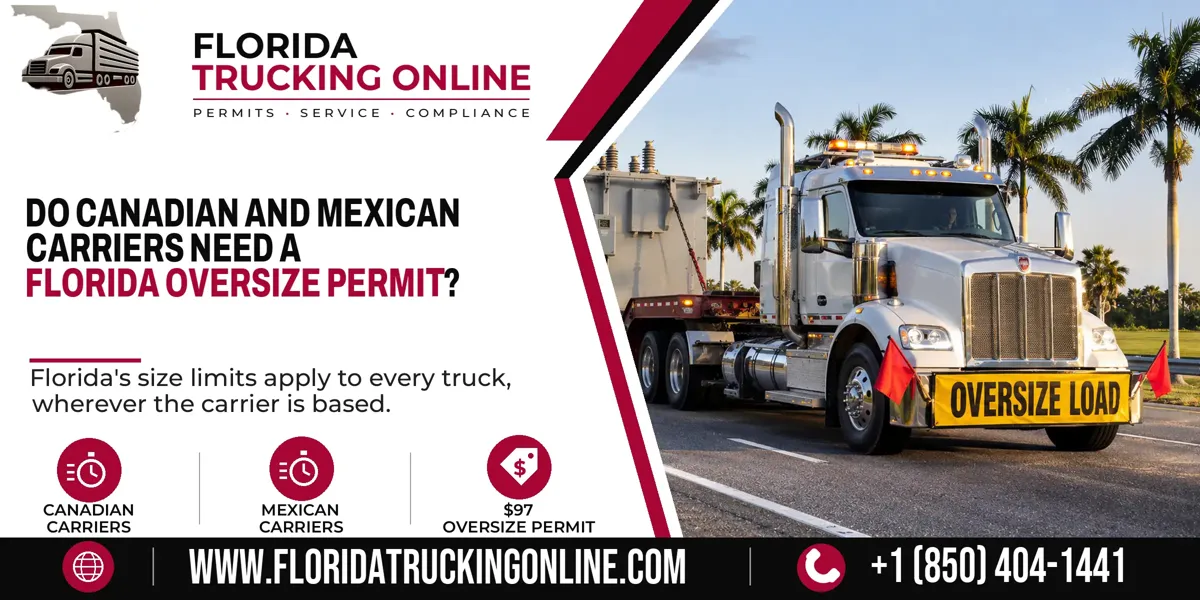
Do Canadian and Mexican Carriers Need a Florida Oversize Permit?
Table Of Contents
-
Introduction
-
The Short Answer
-
What Florida Law Says
-
Florida's Legal Size and Weight Limits
-
Canadian Carriers
-
Mexican Carriers
-
Other Credentials You May Need
-
Metric vs Imperial Measurements
-
Quick Checklist
-
Common Mistakes to Avoid
-
Why Many Trucking Companies Choose Our Service
-
FAQ
Introduction
Heavy equipment, boats, machinery and building materials cross into the United States every day from Canada and Mexico, and plenty of it ends up in Florida. Ports, construction sites and farms across the state depend on these loads.
When the truck or the load is bigger than normal, foreign carriers often ask whether Florida's oversize rules apply to them. They do. This guide explains when a Canadian or Mexican carrier needs a Florida Oversize Permit, what limits trigger it, and which other credentials need to be in place before the load reaches Florida.
The Short Answer
Yes. Any vehicle or load that goes over Florida's legal size or weight limits needs a Florida Oversize Permit, no matter where the carrier is based. Florida's rules apply to the vehicle on the road, not to the carrier's home country.
-
A Canadian carrier hauling an over-width excavator needs the same permit as a carrier from Georgia.
-
A Mexican carrier hauling an over-height transformer needs the same permit too.
-
A load that stays within legal limits doesn't need an oversize permit at all.
What Florida Law Says
Florida sets its size and weight limits in Chapter 316, Florida Statutes. Section 316.550 lets the Florida Department of Transportation (FDOT) issue permits for vehicles and loads that go over those limits. The details, including travel times, escorts, signs and lights, are in Rule Chapter 14-26, Florida Administrative Code.
The law doesn't make an exception for foreign carriers. A permit is tied to the vehicle, the load, the dimensions and the route. FDOT reviews a load from Ontario or Nuevo León the same way it reviews one from Tampa.
Florida's Legal Size and Weight Limits
A Florida Oversize Permit is needed when a vehicle or load goes over limits such as:
-
Width: 8 feet 6 inches
-
Height: 13 feet 6 inches
-
Length: limits depend on the vehicle combination, such as a 53-foot semitrailer
-
Weight: 80,000 pounds gross, plus the axle and bridge limits
The load must also be non-divisible, meaning it can't reasonably be broken down into smaller pieces. Loads that are much wider, taller, longer or heavier may need escort vehicles under Rule 14-26.012, and some moves are limited to daytime and weekdays.
Canadian Carriers
Canadian carriers are used to oversize permits from their own provinces, but a provincial permit doesn't work in Florida. Each state issues its own permit for its own roads.
-
Provincial permits from Ontario, Quebec or any other province don't carry over to Florida.
-
Other U.S. state permits don't either. A Canadian load heading south needs a permit for each state on the route, including Florida.
-
Canadian rules are often more generous. Some provinces allow heavier gross weights than Florida. A truck that is legal at home may still be overweight in Florida.
What it means for you: check the load against Florida's limits, not the provincial ones, before the trip is booked.
Mexican Carriers
Mexican carriers face the same oversize rules as everyone else, plus a few federal steps first.
-
The carrier needs FMCSA operating authority to run beyond the border commercial zones. Without it, the truck can't legally reach Florida.
-
Once the truck is authorized, Florida treats the load like any other. If it's over the limits, it needs a Florida Oversize Permit.
-
Mexican weight rules differ from U.S. rules. A load that is legal in Mexico may still be overweight in Florida.
What it means for you: a USDOT number and FMCSA authority let the truck run in the U.S., but they don't replace the Florida Oversize Permit.
Other Credentials You May Need
An oversize permit covers size and weight only. A cross-border truck may also need:
-
Florida Trip Permit: Mexican carriers aren't part of the International Registration Plan (IRP), and a Canadian truck without Florida on its cab card isn't registered for Florida. Either one needs a trip permit.
-
Florida Fuel Permit: a qualified truck without IFTA, such as a truck based in Mexico, needs a fuel permit.
-
Escort vehicles: large loads may need escorts that meet Florida's rules for signs, lights and equipment.
A single oversize trip into Florida can need all three permits, so order them together and make sure the dates line up.
Metric vs Imperial Measurements
Canadian and Mexican carriers usually measure loads in meters and kilograms. Florida permits use feet, inches and pounds.
-
2.6 meters of width is about 8 feet 6½ inches, just over Florida's limit.
-
4.15 meters of height is about 13 feet 7 inches, already over Florida's 13 feet 6 inches.
-
36,287 kilograms is about 80,000 pounds.
Convert carefully and round up. A permit with the wrong dimensions isn't valid for the load on the trailer.
Quick Checklist
-
Is the Load Over Florida's Limits? Check the width, height, length and weight in feet, inches and pounds.
-
Is the Load Non-Divisible? If it can be broken down, it must be.
-
Does the Truck Have Operating Authority? Mexican carriers need FMCSA authority beyond the border zones.
-
Is Florida on the Cab Card? If not, add a Florida Trip Permit.
-
Does the Truck Have IFTA? If not, add a Florida Fuel Permit.
-
Are Escorts Required? Check Florida's escort rules for the load size.
Common Mistakes to Avoid
-
Assuming foreign carriers are exempt. Florida's limits apply to every truck on its roads.
-
Using a provincial or other state's permit. Each state needs its own.
-
Relying on home-country weight limits. Florida's limits may be lower.
-
Rounding metric measurements down. A small error can make the permit invalid.
-
Forgetting the trip and fuel permits. The oversize permit doesn't cover registration or fuel tax.
Why Many Trucking Companies Choose Our Service
Florida Trucking Online helps Canadian and Mexican carriers get the right Florida Oversize Permit, trip permit and fuel permit before the load reaches the state line, so a cross-border move isn't stopped in Florida.
-
Oversize permit: $97
-
Trip permit: $105
-
Fuel permit: $120
We provide support 24/7 and also work weekends and holidays.
or
FAQ
Do Canadian carriers need a Florida Oversize Permit?
Yes, if the load goes over Florida's size or weight limits. Provincial permits don't work in Florida.
Do Mexican carriers need a Florida Oversize Permit?
Yes, for any load over Florida's limits. The carrier also needs FMCSA authority to reach Florida.
Does a USDOT number replace the oversize permit?
No. A USDOT number is federal, and the oversize permit is a Florida credential.
Can one permit cover the whole trip from Canada or Mexico?
No. Each state on the route issues its own permit.
Does a cross-border oversize load need other Florida permits?
Often yes. It may also need a trip permit and a fuel permit.
For more information, visit the Florida Department of Transportation.