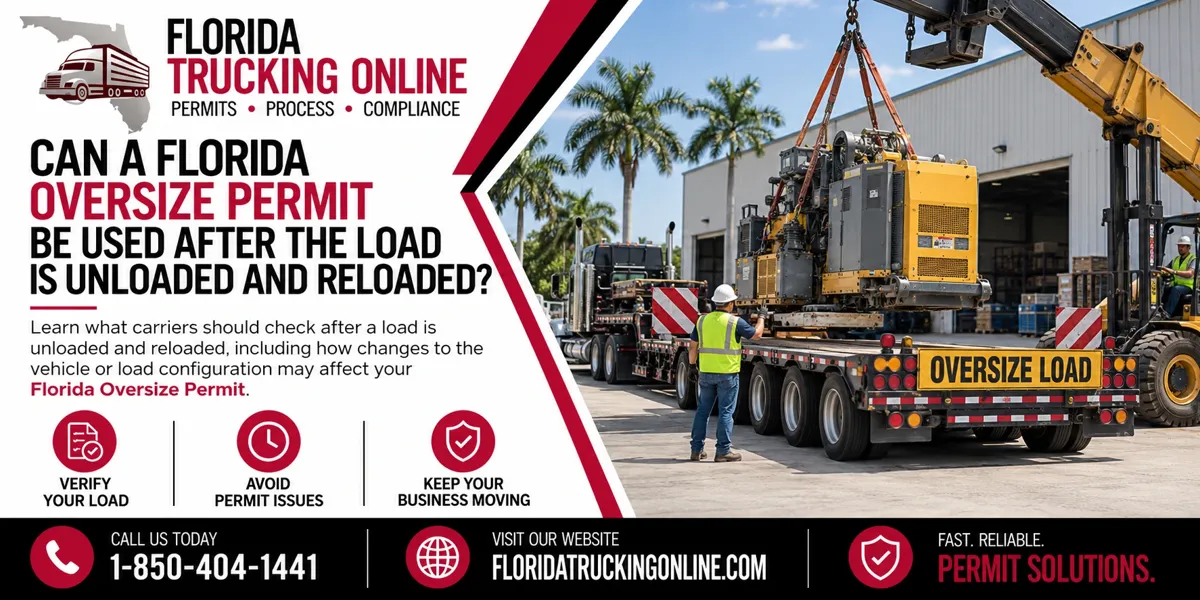
Can A Florida Oversize Permit Be Used After The Load Is Unloaded And Reloaded?
Table Of Contents
-
Introduction
-
Why Unloading And Reloading Can Affect The Permit
-
Is The Original Permit Automatically Valid After Reloading?
-
What Should Carriers Check Before Reloading?
-
What If The Load Is Exactly The Same?
-
What If The Vehicle Or Trailer Changes?
-
How To Prevent Permit Problems
-
Why Many Trucking Companies Choose Our Service
-
FAQ
Introduction
A trucking company may need to unload an oversize load at a facility and later place the equipment or cargo back onto a trailer. This can create a question about whether the same Florida Oversize Permit can still be used after the load has been unloaded and reloaded.
Carriers should not assume that unloading and reloading automatically leaves the original permit unchanged. The permit applies to the permitted movement and the vehicle and load information associated with it. If the configuration, dimensions, weight, identification, or other details change, the carrier should review the permit before continuing.
Why Unloading And Reloading Can Affect The Permit
An oversize permit is based on information about the vehicle and load being moved. When a load is removed from a trailer, the configuration that was originally permitted may temporarily no longer exist.
Reloading can also change how the cargo sits on the trailer. The load may be positioned differently, secured differently, or combined with other equipment. Even when the same cargo is placed back on the same trailer, the final dimensions and weight should be checked.
For example, a piece of equipment may have been loaded at its original location in one position and then reloaded at a second facility in another position. Its overall height, width, length, or axle distribution could be different after reloading.
That is why carriers should verify the final configuration rather than relying only on the original measurements.
Is The Original Permit Automatically Valid After Reloading?
Not necessarily.
Florida has different types of oversize and overweight permits, and their conditions vary. A trip permit is associated with a specific movement, while blanket permits operate under their own applicable conditions.
The carrier should review the permit type and its conditions before assuming that the original authorization continues to cover the reloaded movement.
The vehicle and load should match the information associated with the permit. If the reload results in different dimensions, weight, vehicle configuration, or other identifying information, the carrier should determine whether additional permitting action is necessary before traveling.
A driver should not simply continue because the permit has not expired.
What Should Carriers Check Before Reloading?
Before the truck leaves after being reloaded, dispatch should compare the actual vehicle and load with the permit.
Important details to verify include:
-
Vehicle and trailer information
-
Load identification
-
Overall height
-
Overall width
-
Overall length
-
Gross weight
-
Axle configuration
-
Origin and destination
-
Approved route
-
Travel dates
-
Special permit conditions
The final loaded configuration should be measured and reviewed before the truck begins the next part of the movement.
If any of these details no longer match the permit, the carrier should address the discrepancy before traveling.
What If The Load Is Exactly The Same?
Using the exact same equipment does not automatically answer the permitting question.
The carrier should consider whether the unloading and reloading occurred during the same permitted movement or whether the original trip has already been completed. The permit type also matters.
For a trip permit, the carrier should pay particular attention to the authorized starting point, destination, vehicle information, and load identification. A trip permit should not be treated as unlimited authorization to move the same equipment repeatedly.
If the load was unloaded at the destination and later needs to be moved again, that may represent a separate movement that requires its own permitting review.
What If The Vehicle Or Trailer Changes?
A reload may also involve different equipment.
A trailer could become unavailable, a tractor could be replaced, or the load could be transferred to another trailer because of a mechanical or operational issue. Changing the equipment can affect the permitted vehicle configuration.
Carriers should not assume that the original Florida Oversize Permit automatically transfers to replacement equipment. The new vehicle or trailer should be compared with the permit information before the movement continues.
The same applies if the axle arrangement or other configuration changes during the reload.
How To Prevent Permit Problems
Carriers can reduce the risk of a permitting problem by checking the movement before the truck leaves the reloading location.
A practical checklist includes:
-
Keep the original permit available.
-
Confirm whether the original movement is still in progress.
-
Measure the reloaded vehicle and load.
-
Verify the vehicle and trailer information.
-
Confirm the load identification.
-
Check the weight and axle configuration.
-
Review the route and destination.
-
Check the permit's travel period and conditions.
-
Address any differences before departure.
Taking a few minutes to compare the final configuration with the permit can help prevent a problem after the truck is already on the road.
Why Many Trucking Companies Choose Our Service
Florida Trucking Online provides trucking companies with a straightforward way to handle their permit needs without having to manage every step of the process on their own. Our service helps carriers save time, simplify permit applications, and reduce unnecessary paperwork, while providing practical assistance when vehicle, load, or trip information needs to be prepared and submitted.
With fast processing, accurate permit assistance, and dedicated customer support, trucking companies have a convenient way to manage their permit requests and address the administrative requirements involved in their trips. This allows carriers to spend less time dealing with permit paperwork and more time focusing on their scheduled loads and transportation operations.
FAQ
Can I use my Florida Oversize Permit after unloading and reloading the same load?
Do not automatically assume that the permit still covers the movement. Review the permit type, movement, vehicle, load, and final configuration before continuing.
Does reloading the same equipment make the permit valid automatically?
No. The final configuration and the conditions of the permit still need to be considered.
What if the load dimensions do not change?
The carrier should still review the permit and confirm that the movement remains within its applicable conditions.
What if I use a different trailer?
A different trailer can change the permitted vehicle configuration. The carrier should review the permit before continuing.
What if the load is unloaded at the destination and needs to move again later?
A later movement should not automatically be treated as covered by the original permit. The carrier should determine whether a new permit or other permitting action is required.
Should I measure the load again after reloading?
Yes. The final loaded dimensions should be verified before the vehicle resumes travel.
For more information, visit the Florida Department of Transportation.